
Chapter 1: Restaurant PR
The fastest and best way to reduce costs for a restaurant is to boost sales. Learning how to market a restaurant and increase sales by just 2% is equivalent to a 10% reduction in costs.
I’m ready to help arm you (or if you’re a supplier – help you arm your customers or clients) with 10 of the restaurant PR you need I know to boost sales. To help make it all a little easier to digest and implement, this proven set of 10 strategies will be broken up into a 10 part series with one new recommendation going out per day (appearing first in my newsletter, so sign up today).
The recession has seemed to batter everyone’s spirits. The global recession truly is/was global. While we are seeing many emerging markets recover quickly and then start to accelerate again, much of the mature western markets (U.S., Canada, Mexico, U.K., and other parts of Europe) continue to lag. While we are thrilled for our clients in those emerging markets who are bursting at the seams with growth and possibility, we are also optimistic about the opportunities for clients in flat or falling markets. Fact is, the best time to gain better employees, grow market share, and outshine the competition is when the competition can’t afford to keep up. Recessions are often when you see the biggest gains in market share (just ask Carlos Slim who catapulted to the top spot of the world’s richest men in 2010 with about a $25 billion advantage over Bill Gates and Warren Buffett).
(More here on how the restaurant industry benefits from a recession.)
Okay, let’s begin exploring how to market a restaurant. We’ll start with a general premise: “Sales cure all that ails you.” It’s a lot easier to ride a bucking Bronco than to drag a dead horse. When you have healthy revenue growth, you can fix a lot of bugs and pesky problems others with flat or falling sales have to suffer. Here are a few of our go-to favorites when we need to get some quick restaurant PR wins for clients – and these are pretty universal so whether you run a mom and pop restaurant or a global chain, these can work for you too:
A well-placed story can be worth its weight in gold. Restaurant PR has entered a whole new era with the emergence of social media. Just five years ago, the only way to build a buzz in the media was with dedicated media relations teams and intoxicating pitches to elite journalists. While the fundamentals of media relations and importance of traditional media outlets have not become less important, the new media tools and vehicles to garner publicity have boomed. Just five years ago social networking barely showed up on the Internet traffic monitors, but today it is the bulk of the traffic on the Internet. Publicity and celebrity status are more in reach for foodservice organizations with skeleton crew marketing departments. This isn’t to say publicity itself is “easier” just to say that it’s more accessible now.
Whether you asked Ray Kroc of McDonald’s or the founders of Outback or even the more recent runaway success stories like Chipotle their founders will all tell you the same thing; they had buzz and PR wins that began mounting on top of one another and helped rocket them to the top. The restaurant marketing approaches billion-dollar chains use after they become billion-dollar chains aren’t the same ones they used when they were under that threshold. A commonality is a well-oiled restaurant PR machine.
Consumers trust what they see in the media. Anyone with a checkbook can buy an ad, but not just anyone gets written about. When a brand is worth writing about, it’s worth talking about.
Traditional restaurant PR efforts targeting magazines and trade journals with long lead-times require a very professional, patient, and methodical approach. It takes time – and a great story – to romance traditional media. And traditional media is incredibly important. The long-term impact of a solid restaurant PR campaign can be an absolute game-changer. Fortunately, in the short term, for those seeking more immediate exposure for their story and offerings, new media and publicity strategies can be put in place that have an almost immediate result. The ideal approach is to blend both traditional PR and new media, but no restaurant should be without either. When considering how to market a restaurant remember that restaurant PR is a necessity, not a nicety.
Chapter 2: SEO and Getting Found Online
Getting found online today is another one of those “mandatories of marketing™.” The acronym all too often thrown around by the marketing industry’s version of snake oil salesmen is “SEO” (Search Engine Optimization).
What is SEO?
What does it mean? SEO is about systematically winning the favor of Internet search engines (like Google, Yahoo, Bing, etc) and having them reward your site with top placement. Above the millions of web pages that were deemed relevant, yours was deemed most relevant. Now sure, you want to show up high – and probably do already – for what’s called a “vanity search” (which is when a company or person does a search for their own name,) but what about those other really important phrases like your trademarks, your signature items, your catering division, the name of your new rock star chef recently recruited away, and all of those other phrases like “Orlando Sunday Brunch,” etc.?
What is the Goal of SEO?
The goal with SEO is to leverage the power of online search and influence of the Internet to drive more traffic not just to your website, but more importantly – to your restaurants. For an independent restaurant, the phrases to optimize for are pretty straightforward. For chains, it is important to optimize not just at a corporate level, but on a unit-level too. “Search” is increasingly about geo-targeting. Each location needs to be optimized for what’s unique to that location. For example, Morton’s shouldn’t just optimize for their name, but for “Morton’s of Orlando” and even more specifically profitable unit-level phrases like “Orlando Steakhouses” and “Orlando Steakhouses with Private Dining”.
What is SEM?
You may also hear another acronym thrown around for SEO’s cousin – SEM (Search Engine Marketing). SEM is the online marketing world’s new and more appealing name for PPC (Pay Per Click). Think of it this way – SEO versus SEM is kind of like Public Relations versus Advertising; one you earn and one you buy. For those with big budgets and expectations for almost immediate results, SEM is the go-to tool for instantly boosting an online presence and driving traffic to your website (or promotions). Often, with SEM, you only pay for performance – which is where the earlier name of “Pay-Per-Click” came from. With the proliferation of online marketing strategies, tactics, and methods for building an online brand, the industry coined the new phrase SEM (both because it sounds better but also because it is more reflective of the fact that there are many other choices to marketing online than just buying pay-per-click ads on major search engines like Google, Yahoo, Bing, and others. For the purposes of this article though we’re just looking at SEO (more to come on SEM in the future).
We recommend to clients that they take a two-pronged approach that includes both SEO and SEM. SEM allows a new site or restaurant company new to building an online brand get some immediate traction and build traffic. SEM is costly though. While you often pay for performance, the little charges add up very quickly. Over the long term, if you build your SEO program effectively, you can reduce costly online advertising and pay per click to advance up the search results organically.
While the major search engines change their algorithms daily, there are a few timeless principles to consider for SEO. By the way, there are two types of SEO campaigns — one called “White Hat” and one called “Black Hat”. The first is the “good” way to win the favor of search engines and the latter is the sneaky stuff cheaters use to try and shortcut the search engine algorithms. We advise to only use “White Hat” approaches. Below are just a handful of the 100+ factors that play into search algorithms:
1. Domain
The name of the domain plays a big part in how well you do for certain phrases. For example, since my name and domain are the same, when you type in “Aaron Allen” in the search box you will find that www.aaronallen.com shows up in the top spot. This didn’t take much effort. There were few competitors (although I was surprised to learn how many more people there are in the world with my same name – I grew up thinking I was the only one). Building up the new domain for other phrases though (like “Restaurant Speaker”) take more effort. Other SEO tools must be employed (like a long tail URL which includes the keyword in it; for instance, the page www.aaronallen.com/restaurant-speaker has the keyword phrase in it which helps with the “domain” part of the algorithms. This SEO technique is often referred to as “long-tail URLs”). For each phrase you want to rank high for, build a dedicated page with the term in the URL extension.
2. Domain Registration
The length of time you register your domain is important. There was a rash of domain owners that would register a domain for the minimum length and build “link farms” and other “Black Hat” schemes and then once caught shut down the sites. Therefore, many of the search engines check to see how long the domain was registered for and reward those who paid a few years in advance (the maximum length is 10 years advance). Make sure your domain is booked at least 3–5 years out. In addition to how far out you register the domain, the original date of registration matters too; older domains have favor.
3. Page Title
The URL of the page is important but it is also important that you name the page for the phrase you’re going after as well. A page title is like the title of an article in a magazine; it should tell you what the content is all about.
4. Title Tags
The headlines and sub-headlines you use in the body of the page you are optimizing also count. These are often called h-tags (h2, H2, h-2, etc.) referring to the big/bold font you use. Just as on paper, when you put things in bold, underline them, etc, you are communicating that it is important to the reader – the search engine “spider” is reading the page too, just using the hidden language of computer code.
5. Keywords
The keywords can appear both in the actual copy and also in what are known as “meta tag descriptions”. The way I often describe this is to have you imagine that the search engine is an employer. This employer pays “spiders” to crawl the Internet all day and night. Each search engine may have millions of these spiders employed. The reason why when you type a phrase into Google and get 11 million results in a fraction of a second that it can deliver so many so fast is that it already knows the answer to the question. Meaning, for any phrase, Google had its spiders find the results months ago and the answer is just waiting there for you to ask a question.
So how do the spiders know what to rank high? Well, taking the analogy further, think of all these 100+ search engine factors used in a search engine’s algorithm as “spider food”. Some of the food “tastes” better to the spiders than others. The more “food” you put out there, and the better tasting it is, and the more often you put it out there, the more you train those spiders to come to your site expecting tasty food and the more they brag about you to their employers – the search engines. In other words, put lots of quality content on your website frequently – just like you’re trying to turn a stray cat (or search spider) into a pet. Okay, all of that to say, “keywords” are really tasty “spider food.” So tasty, in fact, you can’t feed them too much (or put too many keywords) on a single page or you’ll make them sick. Limit keywords. Focus on one per page and don’t “stuff” the page (or overuse keywords).
6. Image Tags
Spiders can’t see images. While photos, videos, and “flash” on a webpage look great to human visitors, the spiders are reading the page differently. Think of them as reading your site in Braille. They “crawl” over the site and read the code. Some website designers will haphazardly use weird file names for the content they put up when a simple technique of naming the images the same as the phrase you’re optimizing for could make a big difference. For instance, on your “Sunday Brunch” page you’re trying to climb up the engines with, instead of using a file name like “image91211.jpeg” just renaming it to “Allens-Seafood-Restaurant-Sunday-Brunch-Panama-City.jpeg” can give you a big boost.
7. Inbound Links
When other sites link to yours it gives you a nice boost. Both the quantity and quality of the links matter; but between the two quality matters more. By quality, I mean that the search engines give a type of credibility score and if the other websites that link to yours have high credibility (i.e. you get a link to your site from the Wall Street Journal; you are listed on a site review site voting for best Sunday Brunch and get lots of links to your Sunday Brunch landing page; etc); and also all of the other factors above – if the sites linking to yours do all of the above (and a whole lot more) right, that increases the quality of the link and therefore your score for this aspect of SEO performance.
The above list is very limited due to length, complexity of the subject, and modern-day attention divs. If it is any indication of how much is involved in all of this, I do a full eight (8) hour workshop on SEO and barely get to all of the big stuff. The Internet is growing at such an incredible rate of geometric progression that the methods for getting a single webpage to stand out among the billions of other pages on the site has become a specialization within a specialization.
This brings me to one of the important points on the subject of SEO. Many restaurant executives and marketers (understandably) don’t have the time to become experts at SEO and farm it out and think it’s being taken care of by the agency. Often the company that designed the restaurant website says “we are going to do some SEO as part of the design and submit your site to all of the big search engines”. This sounds like it’s “handled”. The area of design and digital marketing has become so complex though that it requires distinctly different specialists to build a modern-day restaurant website and SEO program. Some restaurants have one jack of all trades build the whole thing. In actuality though, usually, the best “designers” are not the best “programmers” – and vice versa. And in all likelihood, while both may know a little about the other’s job – and think they know about SEO – it is such a complex, competitive, specialized and important area of marketing that it often requires more than what the typical designer or programmer can bring to the table. For the big brands out there they often have teams of SEO specialists which are totally separate from their SEM specialists.
Okay, that may have overcomplicated what I was trying to say. The main point is that good SEO – like a good public relations campaign — is about consistency of effort. It’s not really a “set it and forget it” aspect of marketing. That said, if you stick with it, you can earn those really top spots in the search engines and win swarms more customers than your competitors. The search engines make it hard to climb to the top; which is challenging when you’re just starting out but terrific when you rise above the competition.
Don’t let the complexity of this scare you away from learning more about it though. Keep in mind this is just a single article on a really big subject. The best way to eat an elephant is one bite at a time. Likewise, SEO is something you can learn just a little about each day. Don’t be intimidated by it. Gaining just a basic understanding and applying a few simple techniques can really pay off for restaurant companies of all sizes. SEO is like planting a garden – you need to start before you’re hungry, but it’s never too late to start and will almost certainly pay off in the long run if well-tended.
Chapter 3: Web 2.0
While hundreds of thousands of restaurants around the world now have some form of online presence, many are still in the old Web 1.0 era of static brochure-ware sites. A million dollars or more may have been spent on the beautiful new renovation or build-out, but 40% of the restaurants’ customers are making a go/don’t-go decision based on yesterday’s El Cheapo website.
I’m often surprised how many entrepreneurs brag about how little they spent on their website or glow with pride (like a proud parent of their child’s finger painting now on the home refrigerator) that their nephew was able to build their site over the weekend for $50 and a six-pack of beer (we like to call this “nephew marketing” – and please note; my comments aren’t meant to be derogatory to others but cautionary to you – this isn’t an area of your business that should be left to novices or relegated to the interns because it’s some less important and periphery marketing “project”).
To be sure, how to market a restaurant website isn’t about how much you spend it is about strategy. The point is that an effective web strategy and embracing Web 2.0 shouldn’t be some afterthought or the type of thing one can put off because it’s not as understandable as other parts of the business or not a glaring red light on the executive dashboard. The point is that if you and your organization are serious about competing in the restaurant industry of tomorrow, you either must know this stuff or bring on some people who do because it is not going away and it won’t get any easier to understand or less important going forward.
Your Website Should Be Your +1
Your website should be viewed as your “+1”. Meaning – if you have one restaurant think of it as having a restaurant +1. If you have 1,000 restaurants, think of it as having 1,000 +1. The “+1” is your online location. It can’t be an afterthought. In fact, if you do happen to have 1,000 locations, your website is very likely the most important location of all of them you have (as it will host more media, investors, analysts, franchisees, industry influencers, etc than any single one of your other locations).
You don’t have to spend on it what a restaurant unit costs (although some of the big chains spend that and more these days), but you do have to approach the design, construction, maintenance, and future planning of your online presence with the same level of detail you did with your physical locations.
It makes no sense to serve a $48 Ribeye on a paper plate and give customers a plastic “spork” to eat it with. Likewise, it makes no sense to spend money on traditional advertising at the expense of your website. Dollar for dollar, digital marketing almost always packs more punch today than traditional yester-year advertising.
How to Market a Restaurant in Web 2.0
Now how to engage in Web 2.0 is a big subject with lots of moving pieces. I love discussing it and teaching the principles to others. I won’t do it the disservice of trying to sum it all up in a paragraph. I will be posting much more on this subject in the future to my blog and break this subject up into smaller more digestible pieces. The call to action here though is just that you get thinking and researching and moving toward embracing the idea of “Web 2.0” Many experts still argue about where it’s at and where it’s going, but you won’t find a single one that would suggest it’s going away.
A Few Must-Have Elements for Any Restaurant Website Include:
- Social Media: Add your account links for Facebook, Twitter, and YouTube. It is advisable to put these in the footer or global content area of the site so web-savvy visitors don’t have to search for them. Also, it is often advisable (depending on who is managing the account) to put a “feed” of your social media on your website too (streaming your Twitter updates, for example). This helps cross-pollinate your accounts and engage with customers in prospective customers where they are already.
- Full Address: A surprising number of restaurants list only the phone number or street address but doesn’t say which city or state. By showing the full address, your website is more likely to get indexed in review sites, geo-search results, and various phone applications consumers use to find new restaurants.
- Map & Directions: While many smartphones and mobile devices allow users to click an address on a webpage and pull up separate directions, some Internet browsers do not. Therefore, to save visitors from re-typing your address into a separate mapping tool, set up your site so with just a few clicks they can see where you are located and get directions from where they are now. One of the best tools for this is Google Maps integration.
- Mobile Compliance: There are more mobile phone users in the world that PC users surfing the Internet. It is essential that your menu can be viewed from popular mobile browsers. Have a full mobile compliance test run on your website to be sure it works across the various browser types. For instance, many websites still use Adobe Flash which isn’t supported by many Apple devices (rumor is Steve Jobs is blocking Adobe to weaken the company and do a takeover, so this may change soon – until it does though, be sure your site works on mobile and tablet versions — two of the fastest selling products in human history that can’t be ignored).
- Media Room: Journalists considering your company for a feature story (maybe a profile on your hot new chef or one of those coveted trade magazine articles about your new franchise plans) will often go first to the website. Make sure to have a publicist take a look at your online media room to be sure it meets all the necessary requirements (press kit, press releases, b-roll, high-res photography, bios, company history, etc).
- Blog: You can cancel dependence on an outside web design firm by using free blogging software as the backbone of your site. This won’t work for all sites, but you’d be surprised how much you can do yourself using a service like WordPress. While we have teams of designers, with our website based on WordPress, we can make our own posts and update/change content without any help. You could do the same (quick price changes, adding new specials, improving copy, etc.) and save that 24-48 hour delay that’s usually there with getting the IT department or outside design firm to make the little change for you. You will want to have a professional do the initial design, but let them know you want it set up on a tool that allows you to make your own changes add blog posts. Also, blogs are a great way to keep adding SEO content.
- Data Capture: Your customers WANT to hear from you. Help make it easy for them to stay in touch by offering a free newsletter sign-up form on your website. Also, do plenty of data capture off-line too (more on that in a future blog post).
- Optimized Landing Pages: You don’t need to optimize every page of your site; just every page you want to be found easily. The more content you put on your site – and the more frequently you do it – the more hooks you have floating in the Internet ocean of prospective customers, employees, journalists, analysts, investors, etc.
- Menu: As stated above, the menu should be viewable from phone, but I wanted to add here another suggestion – make it easy to email a direct link to your menu. Many times, friends will want to suggest a restaurant and show a menu to get others excited. Some sites bury the menu in the site or have a URL address that is too long to either re-type or forward. Consider a share tool to make it easy to email the link or post to social networking sites (like Twitter and Facebook).
A Few Optional Elements to Consider for Your Restaurant Website (These Vary by Brand/Concept), Include:
- Video: Studies show that video produces much higher conversion rates than plain text or email alone. If you have the budget to produce a professional video do so and put a compressed (easy to load) copy on your site to help personalize the brand. Don’t try this at home – oftentimes amateur videos of food can do more harm than good. There are plenty of online video companies out there these days that can do online videos for as little as $500 turnkey.
- Restaurant Locator: For chains – beyond just offering a directional tool – consider a locator tool. One note though, be sure not to restrict it to ONLY allowing the locator. I have been frustrated to no end trying to order online with Papa John’s in markets where I didn’t readily know the zip code – they lock you out and restrict access altogether. It is too restrictive and is doing more to restrict buying than encourage it.
- Financial: Public companies have strict financial reporting guidelines and many of them already have a robust financial section on their site for investors and analysts. For private companies, this is still a good place to post your more favorable results. Whether you’re looking for new investors, to be featured in a business news article, or looking to build a positive picture of the company, having a section on your site to communicate your results and plans is often a good idea.
- FTP/ Support Login: For multi-unit operators, we encourage that you have a private log-in section for your field managers. Whether your system is corporate or franchised or both, there is always information to share and exchange. Doing this digitally is the best approach. Some companies do so via email but this can be dangerous. Creating a log-in section, you can post information with more protections; such as restricting access, tracking file histories, allowing files to be seen but not distributed, or updating something like a 300-page operations manual in an instant rather than mailing out new printed versions every time there is a slight change needed. This is also a great place to store your corporately approved and encouraged marketing materials for managers or franchises to pull down and produce locally.
Your restaurant website is the second most important piece of marketing collateral you have second only to your menu. It must be viewed as an organic and evolving component of your brand rather than a static and abstract communications tool. Again, think of it as your +1 and have it managed just like the unit-level is managed. Someone has to keep up with it and stay on top of it like the restaurant restrooms; only this restroom is on full display and not just every customer but every prospective customer enters through the restroom first.
Chapter 4: Menu Engineering
The core of how to market a restaurant is your menu. Everything from the kitchen design to marketing to hiring to location strategy – it’s all rooted in the menu. How many items should there be? Where do we buy our ingredients? How do we price our menu? Is there a gap between our theoretical and actual food cost and if so how did it happen? What should we discontinue and what should we expand on or enhance? Should we do a separate lunch and dinner menu or one all-day menu? How can we increase our margins without just a blanket price increase that may scare off our customers or reduce their visit frequency? The answers to all of these questions are pursued in the process of menu engineering and analysis.
Think of menu engineering as the CSI (you know – that Crime Scene Investigators series on TV…many of my readers are outside the U.S. – 123 countries last month – not sure if CSI is in all of them) of restaurant menu strategy. At any rate, what I’m trying to get at is that menu engineering is the “science” part of the culinary arts. It’s about exhaustive analysis of menu sales and profitability where all the myriad of data points are tabulated and cross-tabulated and studied; all toward the intent of yielding actionable insights on how to make a restaurant menu more profitable to the restaurant and relevant to the consumer.
The process of restaurant menu engineering reveals significant trends, insights, “profit siphons”, and opportunities for item line-extensions and new item introductions. There are several components to menu engineering including:
1. Menu Profitability Analysis
Menu profitability analysis delves into the cracks and corners of menu sales performance to uncover hidden gems of untapped or under-leveraged profit potential. Remember that scene from “A Beautiful Mind” where Russell Crowe’s character sees volumes and reams of numbers fall away and numerical patterns, mathematical theories, and an exciting new, game-changing hypothesis emerge from the chaos? That’s what can happen with menu profitability analysis. Okay, I romanticized it a bit – and at times the process of menu profitability analysis can make one feel as nutty as Crowe’s character was in that movie – but I can say honestly that at times you do have these eureka moments where numbers crumble and behind them you see patterns that would otherwise not have revealed themselves. You don’t have to be an accountant or math-wiz to come to enjoy menu profitability analysis. If you like a Sherlock Holmes film or crossword puzzles or snorting around in the backyard with a metal detector, you may like doing menu profitability analysis. Whether you like it or not though, if you want to increase sales and profits for your restaurant organization, you or someone who works for you needs to go on the needles-in-a-haystack-hunt that is menu profitability analysis.
How do you do it? Good question. I’ll stop with making the homework sound like a fun game and try to succinctly describe how you do it and what mantras to say out-loud as you’re doing it.
The idea is that “you deposit dollars, not percentages”. The standard “target” food cost is roughly 30% (lower for QSR’s and higher for, say, a casual dining steakhouse). Some items on your menu will yield a lower food cost and therefore a higher percentage profitability. But, which “renter” (my “renter” analogy closes this article, but go with me for now) do you give the prime space to – the one who pays you a bigger percentage of their paycheck or the one who pays you a big rent regardless of how much or little of their paycheck it was?
A profitability analysis of your menu will show you which items are (enter any variety of catch-phrase ways various consultants have come up with to call the four quadrants in a standard economic two-by-two diagram, here): #1) high in sales quantity and unit profitability, #2) high in sales quantity but not unit profitability, #3) high in unit profitability but not sales quantity, #4) low in unit sales and unit profitability. Essentially, what all of this tells you is – on a category by category basis – #1) which items to make more prominent on the menu and/or find “line extensions” and new variations of to promote in the future as LTO’s and future permanent add-ons, #2) which items to “re-engineer” so that they become more profitable (like adding bacon to the standard cheeseburger as an option whereby both the price and gross margin are increased), #3) which items to consider giving a “promotion” on the menu into better real estate so they can shine (and a number of other techniques to take high margin items that are low in sales quantity and increasing the quantity – or just realizing they are too unique to go mainstream and doing something else with them), #4) which menu items aren’t paying their fair share and are deadbeats that should be evicted.
Whew! That was a lot to sum up (and to absorb) in a single paragraph. While I realize some of my readers are rolling their eyes and thinking “child’s play”, please keep in mind our clients have ranged in sales volume from $250,000 to $12,000,000,000 (yes, 12-Billion) and we try to offer content relevant to all ends of the spectrum. Plus, even at the high end of the spectrum, you will concede sometimes this stuff is easier to just discuss and comprehend on an intellectual level than it is to actually produce. Let’s just say it like this – menu profitability analysis is commensurately difficult to the complexity of your restaurant organization but it is commensurately beneficial to endeavor to perform the analysis, make sense of the results, and effectuate the proper changes inside of your organization.
Whether you love or hate menu profitability analysis; whether you do it yourself or delegate it to someone else; whether this analysis is done on a single unit or a multi-national chain; the importance and necessity is equal.
2. Competitive Menu Analysis
Menu pricing strategy doesn’t happen in a vacuum. Naturally, it is important to study your own theoretical food costs and profitability targets, but this analysis must often be weighed in the context of the competitive landscape.
A competitive menu analysis is a study of price, portion, preparation, and presentation of comparable menu items for the competition as well as an overall general segment benchmark of how you stack up against others in your industry category and segment. This is done by conducting a “by-category” and itemized comparison of the competitive set and non-competitive benchmarks.
For example, you would take your appetizer category and list all items to see your highest-priced, lowest-priced, and total quantity of items in that category. Then you stack the same information for the competitors and benchmarks. This helps you see how you compare in terms of actual pricing, “perceived pricing”, variety (too many items and you may be carrying bloated inventory or make it confusing to customers to sort through, but too few items and it may have an impact on dining frequency due to limited choice).
Some parts of this type of analysis are very much scientific and some are more an art form to compare. In general, my feeling on competitive analysis is that the goal should be a menu (and brand overall) that isn’t easily comparable. When it is, often the two compete on price rather than value.
3. Inventory Issues
Inventory issues play into an overall menu engineering program and consideration for menu evolution. This would include considerations such as make/buy analysis, inventory turns and par levels, utilization reports (how many SKUs in your inventory, spread against how many vendors, etc) to determine if cost savings may be found with changes to the menu in terms of size, quantity, yield, and general procurement strategy.
4. Restaurant Industry Trends and Menu Trends
This is one of the areas that we see the big chains get off track more so than the independents or regional chains. With all of their armies of analysts, marketers, researchers, and seemingly endless budgets; big chains are by nature slower moving and less inclined to want to see seismic industry or consumer dining behavior change happen. Why? Well, imagine you have 35,000 restaurants and you have to turn all of them on a dime – for a franchise company that’s like getting 35,000 kindergarteners with tempers and lawyers to gleefully follow the teachers every direction when on a field trip (it can be done, but that is one heck of a teacher…uh, hem, miracle-worker of a restaurant CEO).
The mega-chains work on at least an 18-month planning schedule. Some fads (you should not chase “fads” but should prepare for “trends”) come and go in less time. That said, the greatest threat to the big guys and greatest opportunity for the mid-sized chains down through independents is to move faster to identify and respond to emerging restaurant trends that are sustainable. I have a blog post (or a couple) dedicated to this and the idea of “the origin of restaurant trends” that I encourage you to read. The point here though is that effective menu engineering must consider not just what can be “proven” in the here-and-now, but what assumptions there are for the future. All too many restaurant chains became casualties conducting their menu engineering analysis based on what was “true today” but ended up losing out because they didn’t see “what would be” and once that “came to be” it was too late because their ship was too big to change course as fast as was required to become relevant in time; especially since they were working on an 18-month calendar but were already 36-months behind the seismic shift.
Another way I like to say all of this is that “Starbucks would never have been born in a focus group.” We can all look at Starbucks today and applaud Shultz as a genius CEO; but if most of his same cheerleaders were asked in 1971 if what would come to be would have come to be, they would have asked for him to have a CAT scan. What Shultz did was part art and part science and part entrepreneurial bravery. He didn’t point to what was to build his case; he built a story and vision of what could-be. The Starbucks menu has evolved, but even at the start it wasn’t about what was proven to be sell-able prior or even at the time – it was a bet on what could happen in the future with solid category leadership. Likewise, as you consider your own menu strategy – which is at the core of your entire foodservice company strategy – think not just on what has worked up until now, but on what could be the future. Dream as bold as you like. Success favors the bold. You could be thinking of your neighborhood or your entire category of the industry. Or, maybe bolder still – creating an entirely new category (which is what the truly GREAT ones did – name one, that’s what they did).
5. Other Operational Issues
Naturally, there are a wide range of other considerations that play in to fully “engineering” a new menu. There are plenty of other factors chains must consider such as seasonality and availability of ingredients, consistency of product across various markets where different suppliers/distributors may be needed, the considerations associated with having an established corporate commissary or centralized culinary operating model versus decentralized – there’s a lot to it. For purposes of this series, I am limiting the purview of menu engineering to a restricted scope which can be accomplished without a total overhaul of the restaurants purchasing, supply chain, kitchen layouts, etc.
Menu engineering can be (in a very simplified nature for chain executives reading this) conducted by a single person and still yield powerful insights that can influence the entire organization. My intent with this article is to suggest that no matter the size of the restaurant system, menu engineering is more than a back-of-house or “culinary department” effort; menu engineering is a critical aspect of the marketing department’s scope of work too. The menu being the core of the entire operation means that ALL levels of the organization can play a part in the overall menu “analysis”. For certain though – whether pursued by an inter-departmental team, or a single owner/operator, or mandated by a forward-looking chain CEO – menu engineering is one of the surest ways to improve sales and profitability in the short and long term. No proper discussion about over-arching programs to drive sales can be complete without also factoring in the overall menu strategy – and that starts with a fact-based and analytical approach to menu engineering.
An easier way to look at all of this is to think of yourself as a landlord and every item on your menu a tenant. Like with all real estate, some locations are more valuable than others. In a three-panel menu, the center of the middle panel is your “Boardwalk” (or prime, most valuable space) and the right panel bottom is your “Baltic Avenue” (or “menu Ghetto”). The restaurant menu engineering process is an analysis to help you determine who is paying their fair share and who needs to pay more or be evicted.
Chapter 5: Menu Engineering & Design Considerations
The single most important marketing collateral a restaurant possesses is its menu. One of the surest ways to effectively and measurably increase sales, profits, and guest satisfaction scores in a manner that is both quick and sustainable is to roll out a new menu. The menu should function as a tour guide and prove to be the best salesperson in your company. Menu engineering and design is the perfect marriage of both the science and art of successful restauranting. If you look at any lauded and successful restaurant turnaround, you’ll see signs of the CEO focusing on the inside and working outward; and find more specifically that a new menu was at the heart of the brand renaissance.
We adamantly believe menu engineering and design requires multi-disciplined team approaches. The process must be rooted in your operational capabilities, brand platform, and culture so it demands involvement from nearly all departments (finance, culinary, marketing, operations, etc). It can’t be done in a vacuum and yield its fullest potential. That said, hiring outside experienced and specialized help can expedite the process and facilitate more cross-departmental collaboration, contribution and buy-in. If you’d like a complimentary assessment of your menu – send us the current in-use version of your menu and cover letter. We’d be happy to proffer some thoughts and suggestions.
Chapter 6: Signature Items
Part Six of Boosting Restaurant Revenue explores how focusing on just a few key signature items can turn the tables quickly for under-performing brands and further propel growth-minded restaurant companies.
In this issue we’ll cover:
- How signature items are used in turnarounds
- How signature items are used to create category leaders
- What’s the difference between a signature item and a menu strategy
- Why signature items are necessary for owning an industry category
- What the British pub failures can teach us about menu strategy; and why the American breakfast category may suffer a similar fate
- Who I think is one of the best turnaround guys in the industry and how he does it
- My recommendation on the best place to inspire your plate presentations
- How I boosted one restaurant’s sales and profits by threatening customers with a “curse”
- What the Pantagonian Toothfish can teach you about marketing
- Which 11 restaurant industry trends to consider when brainstorming new signature items
All of this and much more in a fully-packed Part Six; let’s begin!
Signature Items for Turnarounds
If you study it, you will find that nearly every successful restaurant turnaround had a new menu strategy as the cornerstone of their brand renaissance. At the center of a new menu strategy is the “Signature Item”. A signature item can be leveraged not only for successful turnarounds. In fact, one could argue that signature items are what created category leaders in virtually every industry segment.
Signature Items for Category Leaders
The strategy of focusing on signature items isn’t just for those restaurant brands seeking a turnaround. Far from it. In fact, if you look at the top players in the industry – category by category – you will see that in nearly every case they have something that they are absolutely known for. Examples? PF Chang’s = Lettuce Wraps. Outback = Blooming Onion. Sure, others offer knock-offs of these items, but the credit for “owning it” goes to them for claiming them, focusing on them, and making a commitment to owning them. You can of course also look back at older examples such as: McDonald’s becoming the world’s largest foodservice company by focusing on the burger and fries (countless chains do that now but McDonald’s pioneered it as a “signature”). Burger King focused on “flame broiled” decades ago as competitive positioning against McDonalds and became the #2 burger chain. KFC owns the chicken bucket. Chick-fil-A owns the chicken sandwich. Zaxby’s owns fried chicken fingers (someone else pioneered what Zaxby’s is doing but didn’t leverage it properly; Zaxby’s came along and owned it such that now the originators of that concept look like the copy-cats). Want more recent? Kogi BBQ is one of the most recent emerging brands and they hands-down own “Korean BBQ”. What’s Korean BBQ? Exactly! Kogi more or less invented it. Now they own it and they are reaping the benefits of innovation. Sometimes the signature item can be so successful it creates a whole new industry category.
Sometimes a Signature Item Isn’t an Item but Rather a Signature Menu Strategy
In some cases, “signature” can go beyond a single item. For example, Chipotle isn’t necessarily known for a single signature item that defines them but rather an entire menu strategy/philosophy that defines them and has become their signature. “Food with Integrity”. Today, you can’t hear someone mention a focus on quality ingredients using sustainable practices and a focus on the source of the food without thinking of Chipotle. They claimed it. They own it. Note: I use Chipotle as an example frequently because they were the top-performing restaurant stock of 2010, are widely known, and are a really clear cut-example; but they are not the only one we see “doing it right.”
Another example of a menu strategy becoming its signature is the 1980’s campaign by Domino’s to deliver in 30 minutes or less – it was bold, they owned it, and they changed the entire pizza delivery industry while becoming a leader in it (notably struggling as of late since they lost their focus on what their menu strategy is actually).
Why is it Called “Signature” in the First Place?
The notion behind an item being “signature” is that it should be like a person’s actual signature. It’s unique, defining; it’s expressive; it’s artistic; and it’s “the bottom line”. A signature also implies a declaration (such as John Hancock’s signing of the Declaration of Independence) and a promise. When you put your signature on a document you are giving your word, staking your reputation, aligning yourself with a certain philosophy, ideal, or acknowledging an acceptance of terms.
I know you know all of this, but read this again through the lens not of what a signature on a document means but a signature item means to your restaurant brand. Get it? It’s a pretty big deal. So, in that view, do you own a category-killer signature item? If not, now’s the time to invent it. If so, get even more credit for it. As Winston Churchill once said, “If you ever have a point to make, don’t try to be subtle or clever. Hit the point once, twice, and a third time with a tremendous whack!”
Signature Items Can Deliver on All Important Metrics
Given that a signature item can be leveraged to take startups from unknowns to category leaders and be used with equal effectiveness to turnaround a large and stalled restaurant system, it is understandably too big of a subject to fully explore in the course of a single article. The point here isn’t to exhaust the subject or give a step-by-step critical path for implementation. Rather, the intent here is to help remind you of what you already know and perhaps see it differently so you’re motivated to look really closely at your own signature item/menu strategy. This is a big topic with immense power and potential for strengthening a restaurant brand, category leadership, revenue growth, profit maximization, employee morale, customer satisfaction, and word-of-mouth marketing. Wow! Anything that can simultaneously impact all of that definitely has to be at the heart of strategic brand leadership. Right?
Below are a Number of Other Examples, Thought-Starters, Case Studies, and Best Practices
What British Pubs Can Teach Us
After the 2008 recession British pubs were closing up faster than clams chased by a screeching otter. Dozens have closed each and every week since the recession. It was enough to drive the public to sob over a drink – and they did – but instead of to a pub, they went home. I don’t mean to at all make light of the devastation and ravaging of the British pub sector. What happened actually had us all here gasping and sighing and feeling nothing but remorse and empathy for those operators impacted. A few years after the worst of it though, this can be reviewed as a case study and lessons gleaned that can help both those who remain there in the UK and also others around the world. For what happened was, in some ways, avoidable for thousands of operators. The lessons learned are applicable to any restaurant system and particularly useful for those operators in mature or declining industry sectors.
- Too Much Alike: You can throw a rock in London and hit a pub — but, for many, the only differentiation was the sign out front or which side of the street it was on. There was hardly a motivation to cross the road. They had no signature items or distinguishable points of difference.
- Failure to Study/Adapt to Trends: Beer has been falling behind for years. Wine and spirits were growing overall consumption volumes and simultaneously cannibalizing the beer category. Rather than adapt their menus, they stuck with what had worked before not what was going to work in the future. I couldn’t understand this one – wine and spirits have higher gross margins so why didn’t they hope for this trend even before the consumers opted for it?
- Commodity: A bottled beer is hard to differentiate. Sure, you can perhaps get your beer colder or try to appeal with a better atmosphere, but short of that the only other way to make it different is with price. Yuck! Competing on price is a terrible approach. Any given day of the week someone else can always beat you on price. No one can consistently be the lowest priced and still have any margin remaining. The consumers this approach attracts will simply follow the deal like a swarm of locust follows the new crops. You can rent this customer but never establish real loyalty.
- Something Else Became More Convenient: There is a saying “One thing you can never do too much of in business is make it too easy to buy from you”. Consumers flopped out of their office and onto a pub stool for quite a while, but eventually, off-premise marketers and retailers made drinking at home more convenient and relevant.
- Beer Makers Homogenized Them: As the margins dwindled, profit-starved pubs were easy targets for beer marketers to buy them, in a way. The pub needed a renovation and marketing support so the beer marketers supplied them with free chairs, tables, taps, promotional materials, window signs, and more. “Here’s something special for you”…and your competitor next door. The deteriorating unit economics had them go along with it. They became homogenized.
- Failure Associations: When “pubs” are closing by the thousands it’s time to reinvent who/what you are to be more relevant than a “pub”. This would have been the perfect time to re-conceptualize the menu strategy to update for new emerging trends and also create an entirely new “category”. This approach would have gotten huge publicity and driven tremendous unit volume for anyone smart enough to do it.
American Breakfast Joints
What’s the difference between Waffle House and Huddle House? How about between Denny’s and Perkin’s? In the breakfast category, Cracker Barrel has a real point of difference. The others in this category seem to cluster together with how they name their menu items, design their menus, promote themselves and a whole lot more. This is pretty common in maturing sectors. There’s a sort of homogenization that occurs as they huddle together to find safety from sagging sales and relevance. Then, the inevitable happens. Consolidation.
We saw this before with the popular cafeteria-style format that worked up until the 1980s for companies like Piccadilly and (formerly) Morrison’s. They grew big, failed to innovate, homogenized themselves so they were indistinguishable from their competitors, the category matured, consolidated, and is now a shadow of itself. Shoney’s is now trying hard to make a turnaround but it may be too little too late – especially if they don’t do something really bold in terms of innovation and new product development. They have a slim chance but if they really focused on the right strategy, a single signature item could help transform perceptions of their menu and ultimately their brand. In many ways the American breakfast category is like the British pub sector. It will not be business as usual and those who do not adapt quickly to changing consumer dining behaviors and emerging trends will disappear.
The way it is shaping up reminds me of the story of the frog who stayed in the pot until he boiled because he couldn’t tell it was getting hotter little bit by little bit. If a frog is dropped in scolding water he’d jump right back out. Similarly, if the CEOs in this industry segment were to be dropped into this pot they’d immediately take corrective action. Since these beleaguered chains are just lumbering about and evolving slower than dining behaviors and marketing approaches are evolving, they don’t see they are about to boil to death in the pot in which they sit. They need to move a heck of a lot quicker than they are to catch up with where the industry and consumer behaviors are headed.
Ruby Tuesday’s
 One of the marketing minds and CEOs I most admire in this industry is Brad Blum. He was the turnaround guy for Darden’s Olive Garden. So successful there he eventually elevated up the ranks to become vice chairman of the chain and heir apparent for the CEO post there. He left for Burger King’s revolving door CEO post and went in with exactly the right strategy for them – focus on flame-broiled and a few core signature items. The franchisees revolted (as usual). Eventually, he (and my point in all this) arrived at beleaguered Ruby Tuesday. His turnaround strategy was to focus on the inside out as he had done with Olive Garden and attempted with Burger King. He worked up those popular signature items that one could argue set off a new gold rush for gourmet burger concepts. His program and approach in the turnarounds of both Olive Garden and the partial resuscitation of Ruby Tuesday’s are both terrific case studies for the strategy of reviving brands by focusing on the inside and working outward (new signature menu items, then interior design, then exterior communication versus new exteriors, then interiors, then menus and training).
Barton G
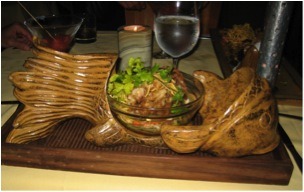
If you’re looking for inspiration on incredible plate presentation approaches then Barton G in Miami has to be on your hit-list. Each dish is plated in the same way art is framed. The plating and presentation of the food enhances and amplifies the experience of the dish in much the same way the frame is selected for the painting rather than the painting being created to match the frame. Now what they do there is over the top and not something a large-scale chain could match or one-up, but the inspiration is there nonetheless. You can’t go to Barton G and not want to re-plate each item on your menu so that the garnish and presentation helps tell a story (rather than that dated old approach of a piece of kale or parsley and couple lemons as the garnish). They bring out a blender for shakes; stuff sparklers in cotton candy; and have plates that are used with only one intended dish. The tuna for example comes out on an elevated platform and sits atop a bead of wheatgrass and has a little Buddha statue on it. Again, this isn’t mass-market kind of stuff, but it is so “signature” that it makes Barton G one of those must-see places for any foodie (and pulls in revenue rumored to be in excess of $30m for the restaurant and their catering operations – which is HUGE!).
Cayman Curse
When I took over operations for a $4 million Caribbean-themed restaurant, I focused in on the bar. We generated nearly 30% of revenues from the bar and were running bar costs in the high 20’s (cost as a percentage of sales). When I studied our purchasing and inventory, I saw that we had stacked up cases and cases of a product that wasn’t moving. Canadian Club had been running a promotion for their new Canadian Club Citrus and so they were giving bottles of it away with purchases of other faster-moving product. Our competitors up and down the beach had amassed mountains of this product too. They started trying to unload it with $2 shots. Then $1. Then 50 cents. No one bought it. People had never heard of Canadian Club Citrus and they figured that if it was selling for 50 cents it couldn’t be good.
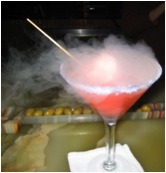
So, I took a different approach. I invented a drink called the “Cayman Curse” and said we couldn’t tell you what goes in it or you will get the curse of the Cayman’s. The recipe called for citrus juices which picked up on the citrus notes in Canadian Club Citrus and masked the Whisky taste. We sold them for $8 and built appeal by putting dry ice in (which makes the drink appear to “smoke”) and supported it with a suggestive selling program. Results? This “mystery drink” made from a previously un-moveable liquor became our top seller. We started trading a bottle of Crown Royal with other restaurants for a case at a time of the product they weren’t moving. Our cost in mixing the drink was so low that – coupled with the huge volume – it brought our overall bar costs down to 16% of revenue. That’s half of what it was! Just one innovative idea and new approach to inventory utilization made a big impact on the bottom line. You don’t have to have a bar though – similar approaches can be taken with different varieties of fish, for example, and you’re not only reducing costs but also taking pressure off other fish species.

Patagonian Toothfish
Necessity is the mother of invention. The Chilean aquaculture industry had a wonderfully tasting fish that few foodies knew of or wanted. The Patagonian Toothfish. Ever see that on a menu? Probably not. Just the name conjures images of a grotesque (uh, image here is not accurate, but what we were probably all envisioning). The Chilean Toothfish and Chilean Sea Bass are the exact same fish. The only difference is marketing. Sometimes a signature item can be discovered by taking something wonderful and undiscovered and presenting it in a more appealing manner. Other examples here are Buffalo Chicken Wings and Flank Steak. Both were once considered undesirable, un-marketable and were incredibly cheap.
When one bar in Buffalo found a use for the chicken wing, he made a killing. No, unfortunately for him he’s not getting a royalty on every wing sold in the world, but when he first started he was buying them super-cheap and doing incredible volume by coming up with something “new” and signature. Now chicken wings – once discarded – cost more than breast meat due to the high demand for them. Likewise, Flank Steak is now outselling Filet Mignon in some high-end eateries. There are plenty more similar opportunities waiting to be discovered by those foodservice marketers looking for them. What the Patagonian Toothfish can teach or remind us about marketing is that perception is reality. If a name or connotation conjures something unappealing or different than what you actually intend it to, it is wise to create a new name (whether that’s a fish species, or a menu item, or a category (like the British “pubs”), or even a brand/company name.
Other Examples
- Discretional Chef: A number of restaurant chains give their chef discretion to purchase what’s freshest and make that the focus of the menu. It’s a signature approach.
- Joes Stone Crab: With sales exceeding $22m in just six months, Joe’s Stone Crab in Miami takes a delicacy that any competitor can also purchase, and puts their signature on it by selling by classification and size of the stone crab such as their “jumbo” and “selects”.
- Lava Cake: Fleming’s Steakhouse recommends their signature dessert while they’re taking the entrée order. Rather than wait too late after guests are full, they explain that their signature Lava Cake takes 45 minutes to prepare and ask “shall I put one in for you with your dinner order so there’s no need to wait?” Nice upsell! Works all the time.
- Chef’s Table & Tastings: Upscale restaurants are finding great success with limited seating chef’s tables and tastings. The kitchen table at Charlie Trotters in Chicago is sold out many months in advance.
- In & Out Burger’s Secret Menu Codes: With a cult-like following, California-based In & Out Burger is widely known for what’s not widely known – secret codes for ordering menu items not on the menu. It’s part of their signature.
Trends to Consider
We’re tracking too many global foodservice industry trends to cover here but a few of them that are top of mind as it relates to brainstorming signature items include:
- Small Plates and Sharing: The days of big plates with overwhelming portions; head-sized desserts that cost more than appetizers; and entrée-only menu programming are out (at least here in the US market – we’re watching how many international markets pursue American restaurant approaches/trends but lag 4-7 years behind what’s hot here so this approach is still working abroad). What’s working better now is small and sharable. Rather than gorge on one redundant flavor, they want to have lots of different tastes.
- Unique Source: Where you get your product will become increasingly important to consumers. This is really heating up.
- Slow and Local: New debates and pending legislation surround what can really be called “local”. Consumers want local though. It’s a hot buzzword and emerging movement.
- Bold Flavors: As Boomers taste buds fade, it takes more kick to rouse their senses. Bold flavors are in.
- Less Fuss: Consumers want the flavors of the ingredients to shine through, not have their food covered in thick sauces and seasonings. Simplicity in preparation is more desired than a dish where the chef was overbearing on the food and bent it to serve his will.
- Authenticity: Fake and “faux” are out. Consumers today want “the real thing”. They want “genuine” and “transparent” and trustworthy authenticity.
- Old Favorites: We’re seeing a successful resurgence of old classics coming back on to menus such as steak tartar, chicken and waffles, stuffed burgers and more. Just as with fashion, some popular periods circle back and become hot again.
- Auctions: Groupon, eBay, Living Social, Home Shopping Network, and more have elevated the “auction” and “limited quantity” appeal/craze to a national and international level of awareness and participation. The “get it while it lasts” marketing approach has been around for a long time but the new popularity is now influencing the restaurant industry. Rather than sell your brand on a discount with something like Groupon’s notion of an auction, maybe you could try a limited-time sell-out dish to pre-order? That’s a new way to get in on the craze.
- Superfruits and Nutrition: The consumer consciousness regarding what goes in their body has been steadily on the rise. Many are starting to remember the old adage, “You are what you eat”, and are paying closer attention to the nutritional value of their food. Some early adopters are taking this further with a “food as medicine” interpretation. Food packed with nutrition is a trend that can’t be ignored.
- Sense of Place: Why would I want to go to Malaysia and eat Buffalo Chicken Wings instead of Malay Chicken Satay? Or Seattle and eat a steak instead of seafood? Increasingly, consumers want food that gives them a sense of place.
- Kitchen to the Bar: Bars that operate more like kitchens – such as chef-driven signature drinks concocted in collaboration with a mixologist – are gaining appeal. More examples on this to come in the future.
A Few More Signature Item Tips and Benefits
- Focus– It can’t all be special. Signature items force the organization to focus on being exceptional on core strengths and messages.
- Make it Easy– We all have too many demands on us. By the time dinner guests make it into the restaurant they have already made hundreds if not thousands of decisions. Signature items make it easy to decide. Making it easy for the consumer is appreciated and you’re rewarded with the higher gross margin often engineered into signature items.
- Reflect Brand– The best signature item you can have is one that reflects your own distinct brand positioning, personality, promise, and story.
- Use Menu Engineering as Foundation– With the brand platform clearly articulated, the next step is to consider emerging trends and also existing performance through the menu engineering analysis.
- Outside Help– Sure, it may sound self-serving of a restaurant consultant to say, but it is nevertheless true that hiring outside help is a short-cut to identifying that break-through signature item. Even the McDonald’s brothers didn’t know what they had until Ray Kroc got involved and saw the potential and opportunities only a fresh eye can spot.
Chapter 7: Improving Staff Morale
The industry has had a couple of rough years in a row now. We’re finding that some spirits are sagging; especially for those segments of the industry hardest hit. It’s important to focus on improving staff morale during these tough times.
In beleaguered chains, the impact on morale runs top to bottom and both managers and their staff are feeling weathered from the sustained pressures and stress. There is no doubt that a restaurant enterprise – and its financial performance – is the sum of its people. Therefore, we are dedicating Part Seven of our ten-part Boosting Restaurant Revenue series to the importance of a talented and inspired workforce. More specifically, we’re focusing on some of the “how-to” for reinvigorating an existing workforce that may be worn down from years of a struggling economy and uncertainty.
For Part Seven we turn to one of the best in the industry on the subject of training and improving multi-unit performance and profitability by improving people – Jim Sullivan.

For those who don’t already know him, Jim has long been one of the industry’s top-drawing speakers and a sought-after consultant. His books have sold more than 650,000 copies worldwide and his client list reads like an industry who’s-who, including companies like Starbucks, Coca-Cola, Walt Disney Company, American Express, McDonald’s, Panera Bread and Apple. I’ve long held Jim in high regard and am excited to share with you some of his thoughts on this important subject.
Following are my questions and Jim’s advice on the subject of reinvigorating staff morale as a means of boosting restaurant revenue:
1. What’s your assessment of the general state of the industry for staff morale? Of course, it varies by organization and isn’t a one-size-fits-all, but based on your wide industry exposure are there any universal observations you can share about where we stand today?
Industry-wide, morale is not as good as it was yesterday but it can be a whole lot better tomorrow. If executive teams/ operators would stay committed to hiring “A” players for their hourly crews that would be a huge start. Then they’d have to make certain their management team was sharp and talented. Stars don’t work for idiots.
2. How can operators assess their own situation and quantify the esprit de corps?
By being able to answer “yes” to the Big 3 questions: Are you meeting and exceeding your goals? Is customer traffic up from last year? Is team turnover less than 20%?
3. What are the hidden costs of uninspired employees and low staff morale? Can you help put a business case on the importance of reinvigorating the workforce as a means of also helping boost revenues?
“Labor” is not your biggest controllable cost, turnover is. Reinvigorate a workforce three ways: 1) hire and develop outstanding managers who have a knack for inspiration, discipline and accountability, 2) prune the deadwood, 3) teach everyone something new every shift.
4. What guidance would you offer an operator endeavoring to build a merit-based reward and recognition system – not just for the line-level staff but for all levels of the organization?
In my experience, “carrots” don’t work. They reinforce only the employees who are already the most engaged and productive in your restaurant or store. Plus most operators create programs that reward individual accomplishment while they preach the importance of teamwork. You’re better off creating a stronger culture in which low performance is simply not an option. To paraphrase Paul Marciano: “Recognition and reward programs fail because they are programs.” These programs rarely lead to long-term sustainable behavioral change because they don’t impact organizational culture. Reward programs are little more than camouflage for ineffective management. If you want to truly motivate your performers to do better, hold those who are not doing their job accountable. Do you want to know what “Quality” is? Conformance to requirements.
5. How do you align shift-minded staff with long-range company goals?
You hire only people with an affinity for learning. Then you teach them something new each and every shift. Then you share your company’s progress and goals every quarter with a State-of-the-Restaurant address to the team.
6. How do you recommend sorting out who to keep, who terminate, and who to promote?
Restaurateurs who complain about the quality if their teams are like someone who’s sitting on a stove and complaining that their ass is burning. Do something about it. Give a lot, expect a lot, and if you don’t get it, prune.
7. How are new technologies and the rise of Millennials changing industry training and people-development in your opinion?
Technology has already transformed ordering, scheduling, back-office systems, and marketing. The biggest impact area of opportunity now is in training. We need to align the way we train to how Millennials live and interact online. Gen Next prefers to create content instead of just consuming it. So training needs to become more collaborative and leverage technology better. Many of our hourly team members – because of technology and the supercomputer in their phones – can, in fact, be better informed or have access to better information than the trainer does. Foodservice trainers today have to get caught up to their trainees technology-wise and mindset-wise. This is very different from the past where trainees had to get caught up to their trainers. The Internet teaches us to avoid the margin-to-margin text of the “training manual” and educate instead via info-nuggets, chunked information and just-on-time training that iPod Generation learners can easily digest and even improve upon by contributing their own experience to the content. I watch how industries awash in cash– like insurance companies, healthcare and hedge funds–train their young people because they can afford to pioneer methodologies that will soon be commonplace for food service companies.
8. What are the emerging trends and some of your predictions for executives to consider as they build their workforce development plans for the future?
Spend more time scaling successes than you do solving problems. Identify pockets of exceptional performance throughout your company and think about ways you can duplicate that success. Make tacit knowledge explicit across your organization. Don’t benchmark other great companies until you benchmark your own.
9. Are there any new tools, companies or websites you have found lately that you think the industry should know about?
I am impressed with the growing groundswell of support and participation that Twitter is seeing among foodservice operators. I am there daily (@Sullivision) to contribute and gain insight into articles, blogs, and websites that I never would have learned about without Tweets. Beyond that, at the risk of sounding self-serving, I’d suggest your readers check out my blogs, articles, and videos at my website where we regularly detail fun and effective new sites and tools that help foodservice operators improve their people, performance and profits.
10. I understand you have a new book coming out. What can you tell us about it and where our readers go to buy it?
It’s called Fundamentals: 9 Ways to Be Brilliant at the New Basics of Business. It covers business basics for the Digital Age leader and reader in a fun design. It’s chockablock-full of great content, ideas, expertise and insight. Fundamentals will be available on the Sullivision.com website in late August and at Amazon and bookstores in September. Read it and reap!
11. You write extensively about leadership and your products are all about developing leaders. What are the three key things that great leaders do?
They take control of what controls their time, they focus on being effective not efficient, and they regularly read industry and non-industry business books, blogs and interviews of thought leaders. Not all readers are leaders, but all leaders are readers.
Chapter 8: New Things to Buzz About
Something has gone wrong at one of my old favorite restaurants. I decided to make my notes for this part in the boosting restaurant revenue series from a table at one of my old favorite restaurants in Orlando – Luma on Park. Five years ago, Luma was the hottest new restaurant in Central Florida. It was a first date kind of place. We entertained some of our best clients here, and for a while I was spending a significant pile of cash here every week, without an end in sight. This was a great restaurant, with an adventurous menu of contemporary American fare, and creating massive buzz throughout Orlando and Central Florida – but judging by my latest visit, Luma has fallen from grace.
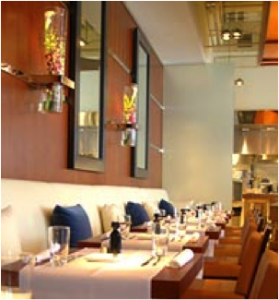
When this restaurant first opened, you needed a crowbar to get in and could expect a two-hour wait before being seated in the dining room. Tonight it was very different. There was no wait for a table, and the dining room was far from packed. Sure, it was a weekday, but you could feel that ghost-of-restaurants-past lurking in the lonely shadows. My previous visits to Luma felt exhilarating, but tonight it felt eerie.
What went wrong? How can Luma get back to the level its fans have come to expect? And what lessons are there for the rest of us?
Luma’s History
Luma burst onto the Orlando restaurant scene with great fanfare. Owned by Brian France, the CEO of NASCAR, Luma had deep-pocketed ownership that was willing to invest in creating a one-of-a-kind experience. Housed in a former bank building, the owners reportedly poured in $5 million to convert the prime corner location on Park Avenue into a restaurant.
This kind of math simply doesn’t work for mere mortal restaurateurs. When you have deep pockets and your first priority is delivering a spectacular experience (even before the imperative of profit), you tend to think about the restaurant business differently than a start-up mom and pop (or those evil, “profit only” chain empires). I watched the launch and progress of Luma with great interest, as I’m always particularly interested in restaurateurs who think about experience first, profits second (whether they have big budgets or not).
I happened to have a meeting with one of France’s top executives who told me that while some wealthy people collect cars, or planes, or mansions, Brian France’s muse is the restaurant business. This passion and level of cultivated personal interest were apparent in every aspect of Luma’s atmosphere. Luma was a pretty spectacular new addition in the local market. Truly they had a hit on their hands.
Five years later, the place is a shadow of its former self.
What Happened?
While it’s hard for me to diagnose what went wrong based on a single visit, I would venture to guess that Luma has been coasting on its previous success.
Too many restaurants fall into this trap: they start out with a big launch, big buzz, and critical acclaim, but then they fail to follow up with something new to buzz about. Eventually, the initial buzz fades, and so does the restaurant.
Even the best, most acclaimed restaurants need to constantly innovate.
Constant Innovation is an Essential
A year or two after Luma opened, one of Brian France’s top executives stopped in to visit us at our office. He was looking for some fresh new ideas, industry insights, and PR strategies for Luma. Maybe this sounds odd – after all, the restaurant was doing blockbuster business, everyone loved it. “If it ain’t broke, don’t fix it,” right?
Wrong. Even though we didn’t end up working together, France’s executive was doing exactly the right thing by seeking out new ideas for Luma. Barely weeks after Luma’s honeymoon period, this guy was on the hunt for fresh ideas to keep Orlando’s hottest restaurant the hottest. (This is what a good “number two” does, by the way – they think about what number one needs before number one thinks about it.)
Keep Pushing
Investing in new things to buzz about might seem unnecessary; isn’t it better to maintain momentum and profit off the restaurant’s existing direction? Rather than staying the course, the smartest investment is to keep ahead of the curve. Some restaurant executives prefer to simply ride out the profits gained from coasting after an initial push; it costs less to coast than to keep your foot on the accelerator. Others recognize that if you take your foot off the accelerator, you may coast pretty well for a while, but if you wait too long you’ll dramatically lose speed, and you’ll end up needing to spend a lot more energy to get back that lost momentum and recapture your market positioning.
How can your restaurants avoid the trap of early success?
Give Your Customers NEW Things to Buzz About Before It’s Too Late
In the corporate world, we tend to plan months, years or decades ahead. Restaurant customers tend to plan just days or hours ahead. Restaurant customers want to know what’s hot TONIGHT – not, what are some guys thinking that they may or may not do a few months from now.
Executives often think about what’s going to be relevant to the quarterly balance sheet or annual stockholders meeting. Customers think about what’s worth talking about, what’s new to experience, what’s exciting and worth my hard-earned money for tonight. Today’s restaurant customer asks, “What’s worth Tweeting about?” That’s how much the attention div has changed.
Renovate or Reinvent Before You Have To

Madonna has reinvented herself so many times it was the title of one of her world tours (I didn’t go; Wikipedia tells me that was the title of the 2004 tour). She has remained a relevant hit-maker for decades now by consistently giving her fans a new dimension to be awed by, her critics something to talk about, and her potential fans a new reason to consider buying in. While Madonna’s clothes, hairstyles, and collaborators have changed through the years, the core of her brand has remained constant. In other words, if she were a restaurant, she hasn’t changed her “brand personality,” “brand positioning strategy,” her “brand promise,” or her “brand story.” She has evolved, ‘renovated’, and reinvented a dozen or more times while still remaining true to the core brand attributes that put her on top.
The same goes for any celebrity or brand that has enjoyed longevity – to have staying power you have to constantly look to one-up yourself. You have to constantly give your fans and critics something new to talk about.
Innovators, Early Adopters and The Tipping Point
The iPhone is the fastest-selling product in history and Apple is now the highest valued technology company in the world as a result. How they got there was not with discounting but with innovating. Consistently, under Steve Jobs’ leadership, the company has believed in the impossible and continuously strived to out-do themselves. That is a key distinction – Apple sees its biggest competitor as not some other force “outside” the company, but the company’s own past performance. Apple wasn’t looking to one-up the competition or win customers by offering a lower price for something that people were already buying. Rather than look for a bigger piece of an existing market, Apple created entirely new markets by dreaming up how to solve a problem and deliver a product that customers weren’t even aware of yet – but that they soon couldn’t live without.
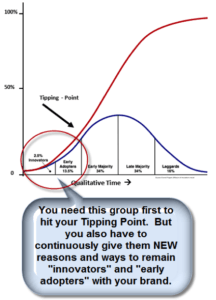
Apple used to be kind of a “niche” company for early adopters and enthusiasts of a certain type of personal computer. Apple was for true believers, while IBM and Microsoft products were mainstream. However, in the past 10 years, Apple has become a mainstream company – not by appealing to more mainstream people, but by transmitting their marketing efforts through their true believers and biggest fans.
To go mainstream and enjoy wide market penetration you have to first win over the “Innovators” and the “Early Adopters” and give them something to buzz about that reflects how they see themselves. Innovators and Early Adopters don’t buy Apple products because of the great features and functions; they ultimately buy Apple products because they believe in Apple’s mission of challenging the status quo, and they see themselves reflected in that mission. As Seth Godin puts it – “A reason to bring it back to the hive.”
Now, most of you have heard this message a few times before and get it. However, what we need to remember is that this innovation cycle isn’t just for startups. Mature or established brands have to repeat the cycle again and again; offering the Innovators and Early Adopters a stream of new reasons to bring your brand back to their hive in perpetuity. Flowers keep offering up their nectar to the bees, giving the bees a reason to come back each day, pick up their pollen, and pollinate the entire garden while bringing back something to sustain the bee colony living in the hive. In this analogy, your brand is the flower and your consistent stream of innovations are your nectar, giving the bees (or customers) a reason to keep coming back again and again.
“If you don’t like change, you’re going to like irrelevance even less.” – General Eric Shinseki
This Video is Worth All 17 Minutes
Seth Godin argues that the era of mass production (Henry Ford and the assembly line) and mass marketing (pushing ideas out to try to “hypnotize” audiences with TV ads, etc.) is at an end. Instead, the new model of marketing is very old: tribes. Your restaurant needs to cultivate a sense of mission to inspire passion and devotion by a community of devoted fans who will go out of their way to connect with you and support your business.
If I gave people what they wanted it would have been faster horses.” – Henry Ford
Starbucks would have never been born of a focus group.
If there is already a case study to show it’s a good idea you’re probably too late.
Surround yourself with people who are comfortable being uncomfortable, who believe in the impossible, who fan the flames of your creative passions. The business world already has enough creative suppression systems in place – there is already an “abundance of caution” in business. It’s often more likely that you are costing your company more by playing it safe than by having the courage to take calculated risks.
Richard Branson didn’t even finish high school and admittedly still doesn’t know the difference between net profit and gross profit, yet he has built one of the most admired multi-billion dollar corporations on Earth. When he thought of going from music stores to airlines to taking his brand literally into orbit (with Virgin Galactic) he didn’t go to the world’s best spaceship designer; he went to the most creative designer he could think of: Philippe Starck.
Neither Starck nor Branson had ever designed a space shuttle before but that didn’t stop them. In fact, their unfamiliarity with the status quo is what propelled them. Sure, they surrounded themselves with lots of technical folks, financiers, and “grown-ups,” but the two creative forces led the project. The technical folks will help make sure the ship doesn’t blow up, but the technical folks would have never taken the leap or conceived the same project.
Richard Branson has built a multibillion-dollar business empire by doing things that other people told him were “crazy.” He believes that life is a relentless process of learning and “turning the status quo upside down.” In this TED talk, Richard Branson discusses some of his most famous and boldest business decisions, like the time he decided to sell Virgin Records for an all-in bet on saving Virgin Atlantic airlines. His business advisors told him it was crazy, but it proved to be the best decision he could have possibly made.

Albert Einstein, when asked what was the most important breakthrough in helping him develop his Theory of Relativity, responded: “Thinking about how to think about the problem.” There are a number of great Einstein quotes that are relevant here.
“Imagination is more important than knowledge.”
“The only real valuable thing is intuition.”
“Great spirits have often encountered violent opposition from weak minds.”
“We can’t solve problems by using the same kind of thinking we used when we created them.”
Famous ad for Apple: Think Different. “The people who are crazy enough to think they can change the world, are the ones who do.”
If that way of thinking was what helped Einstein pioneer groundbreaking scientific discoveries that fundamentally changed human understanding of how the universe works, surely it’s good enough to help our industry figure out how to put a few more butts in seats. He had 24 hours in the day just like all of us. He told us his secret. Heck, so has almost every great achiever or brand pioneer. It was to zig when the competition zagged. It was to follow their intuition more than a case study or feasibility study.
Captain Kirk says it: to boldly go where no man has gone before.
Joseph Campbell: Follow your bliss.
Jack Welch: You have to be on the lunatic fringe.
Seth Godin: Be remarkable.
Chapter 9: Being Remarkable
Being remarkable should be the centerpiece for your vision when you are planning how to market a restaurant. Good food, good service, and good atmosphere are NOT being remarkable. A restaurant sending a steak to the airport for one of your most vocal fans is being remarkable.
That Shankman story has been sent to me a half-dozen times by now. It’s the very definition of WOW. Who wouldn’t feel like telling everyone if they had that kind of experience?
Already the naysayers are exclaiming and dismissing such a thought as impractical, not business-minded, “giving away the farm.” “We can’t afford to do this for our customers! It costs too much money. Better to just keep our heads down, keep buying billboard space and running ads in the phone book…”
When this type of objection used to come up with clients in the past, I would expend the energy, lay out the case, expand the logic and proffer more “realistic” ideas for them to baby-step their way into this more innovative way of thinking. Finally, I realized after much pain and anguish that you can’t baby-step your way to being remarkable. The people who don’t get it are never really fully going to get it, and fighting with them only distracts you from the really important work of finding the people who believe in “remarkable,” and becoming remarkable.
As Seth Godin explains so clearly in Tribes, your followers want to you to lead them. Your followers are the people who believe in your brand: your customers and your employees. And you have many other prospective followers among the silent masses who share your beliefs and are interested in your mission, but have not yet been introduced to your brand. They will be pleased to meet you and to have you lead them.
At the risk of using too many quotes of great men who say it so much better than I could, I wanted to close with perhaps my favorite quote of all in the hopes that any restaurant industry executive or marketer looking for the courage to follow their own convictions – and pursue that big, hairy and risky idea or campaign – will find it in these words of Theodore Roosevelt:
“Far better it is to dare mighty things, to win glorious triumphs even though checkered by failure, than to rank with those poor spirits who neither enjoy nor suffer much because they live in the gray twilight that knows neither victory nor defeat.”
Be bold. Give your customers, employees, franchisees, investors, media, and community something new to talk about. Truly worth a “WOW!” Not a gimmick or following in the footsteps of some other company that did it first, but something that wows even yourself. Something that reflects the true convictions of your brand and your company’s reason for being. That gray twilight is the least safe place to be these days.
AFTERWORD: Just a few days after I wrote the first draft of this article about how to market a restaurant, Steve Jobs resigned as CEO of Apple. So I want to include just one last quote from Steve Jobs, the greatest innovator of our time, from his address to the 2005 graduating class of Stanford University: “Stay Hungry. Stay Foolish.” Stay hungry: Innovators are hungry – they’re restless in pursuing change and challenging the status quo. Stay foolish: some of the best innovations are the “crazy” ones that people think are too unsafe, too risky, too out-there. Be foolish.
DISCLOSURE
A sacred truth and conviction we hold is to keep all clients’ (and prospective clients’) information confidential; in the strictest of confidence to be sure. While there may seem to be an air of familiarity with Luma mentioned in this post, it is derived from publicly disclosed information and personal consumer experience. No confidences were betrayed and several years have passed since we were asked – as many others were – to bid on the Luma business. We hold Luma, its management, and its officers in the very highest regards. The opinions tendered in this blog post are those based strictly on public and non-confidential information and are in no way intended to harm Luma or its stakeholders. To the contrary, we remain fans and cheerleaders for the company and generally hold Luma and the France family in the highest regard as they are among the most remarkable of entrepreneurial success stories in recent American history. We wish them and Luma much continued success. However, we also wish that they would rev up their engines and get Luma back on the right track. Central Florida needs Luma to regain its former glory; there are too few contemporary-oriented restaurants in Central Florida, and we need to keep the ones we’ve got. Like a Ferrari, Lear jet, or beautiful mansion; a great restaurant must be maintained. High-performance vehicles take more care and attention to operate than a beat-up Buick. The same goes for high-performance restaurants. Luma is flaming in its need for attention.
Chapter 10: Know the Trends
A trends list may not seem as tangible and actionable as a list of promotional tactics for how to market a restaurant, but if a restaurant chain is looking to leapfrog over their competitors they need to know the trends. They will need to be able to correctly predicting where the market is going and get there before the consumer or your competitor even knew it was where they wanted to be.
We all know the pace of change is accelerating. And never before has it been more evident that success today favors those companies who innovate. As you scan the restaurant industry for recent success stories you see that the most profitable and fastest-growing concepts are those who are innovating in fast-growing categories and are perceived to be originals. That means not only knowing the restaurant trends, but also creating them.
Ideally, the best positioning you can have is to be the “original.” The second best positioning you can have is to be the “alternative.” In many instances, you can add the market share of #1 and #2 in any category and you’ll find their share is greater than that of #3 through #10 combined. An often-used example to look at is Coke versus Pepsi. Coke is “The Real Thing” (the original) and Pepsi is “The Choice of a New Generation” (the alternative). Any idea who’s #3 in cola? Few do. To be the original, you have to be first (or really early to the party and boldly claim leadership). You can’t be first following the trends. As Henry Ford famously said, “If we’d given people what they wanted it would have been faster horses.” Don’t aim for where the target is at; shoot for where the target will be.
Four Reasons You Need to Know the Trends
There are numerous benefits to being ahead of the trends. Some of them include:
1. Profitability
When you know the trends you benefit considerably. Consumers reward companies that innovate by happily agreeing to pay premium prices. This means higher margins. Innovative companies who know the trends are more profitable than those who ignorantly try to build their business on the quicksand of discounting.
2. Newsworthiness
Journalists know the trends and seek early-adopters to interview and cite in stories about new technologies, trends, and innovations. Just look at Kogi Korean BBQ. When Twitter was just starting to catch on in 2009, journalists were looking for small business success stories of using Twitter for marketing. Naturally, reporters look to the restaurant industry for small business examples. Few mega chain restaurants were early adopters of Twitter and so Kogi started fielding the calls. The story caught on and snowballed (once one news organization covers a story others follow suit and this can create a positive media feeding frenzy). The coverage got so hot that it actually helped spawn a whole new trend and industry category – Food Trucks. What started out as a story about an early adopter of a new trend helped actually create a billion dollar category. By 2011, Food Trucks were listed by the National Restaurant Association as one of the top 10 industry trends for the year. In short, when you are on top of the trends, you get noticed not just by customers and talented professionals who want to join your team, you also get noticed by journalists, investors, partners and more. And, you may springboard even further and create a whole new category that you own and are forever credited with fathering.
3. Beacon of Success
Every one wants to be associated with success. By innovating, you build not only on the results of success but also the perception of success. The success pheromones will attract the brightest people who want to work with you, reporters who want to write about your company, investors and franchisees who want to join with you, and other partners who seem to come out of the woodwork. For instance, we had a client who had tried unsuccessfully for a decade to get an A location in Las Vegas, but after we helped secure a feature story about the client in Forbes, the A locations started courting our client.
4. Market Share
Apple has always made it a priority to know the trends. You can see this with their product development. RIM’s Blackberry has been decimated by Apple’s iPhone. Blackberry – once referred to as the “Crackberry” because it was checked so much in boardroom meetings – is so crippled that it may actually go under, and meanwhile Apple owns nearly 50% of the smartphone market. My, what an astonishing turn of events in just a few short years. It all boils down to this: one company was slow to innovate and sat confidently on its laurels while another company was aiming not just to know the trends, but put together the clues found in the trends and build its entire corporate strategy on a vision of the future. The moral of the story is that even if you are know the trends today and gleefully enjoying that success, you have to continuously look and plan ahead to keep that position. I know you know this already. It’s how you got to where you are today. I’m simply offering a humble reminder – innovation is as important as ever before, change is accelerating faster than ever before, and your commitment know the trends has to be commensurately prioritized.